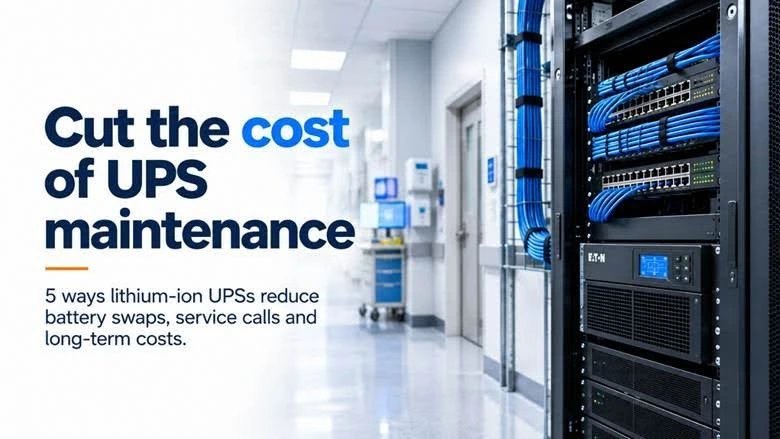
Managing one uninterruptible power supply is easy. Managing them across every IDF, rack and telecom room in a hospital is a different story. Here are 5 ways lithium-ion batteries can cut maintenance, save space and make life easier for IT and facilities teams.
5 ways lithium-ion UPSs lighten the load on hospital IT and facilities teams
A hospital often has centralized backup power for life-safety systems — the devices keeping patients alive — but network closets, telecom rooms and racks often still rely on local single-phase uninterruptible power supplies (UPSs).
Across a large facility, those units add up fast.
And when every one of them depends on batteries that may need replacing every few years, so does the maintenance spend.
What the UPS is doing behind the scenes
Nowadays, single-phase UPSs do more than keep equipment alive during a power outage.
They can continuously condition incoming power, protect switches and other network equipment from voltage problems, prioritize critical loads and give IT teams remote visibility into UPS and battery health.
That makes them a key part of keeping distributed network infrastructure stable across IDFs, telecom rooms and racks.
Explore Eaton’s single-phase UPS solutions and how they can benefit your customers’ facilities.
The battery choice determines how much ongoing maintenance comes with that protection.
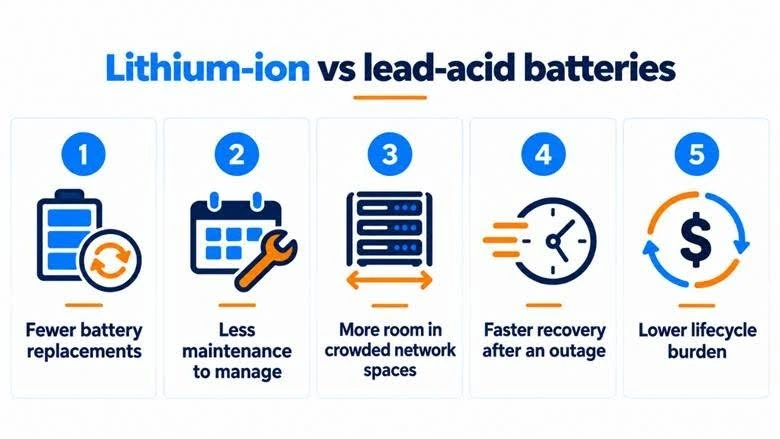
1. Fewer battery replacements
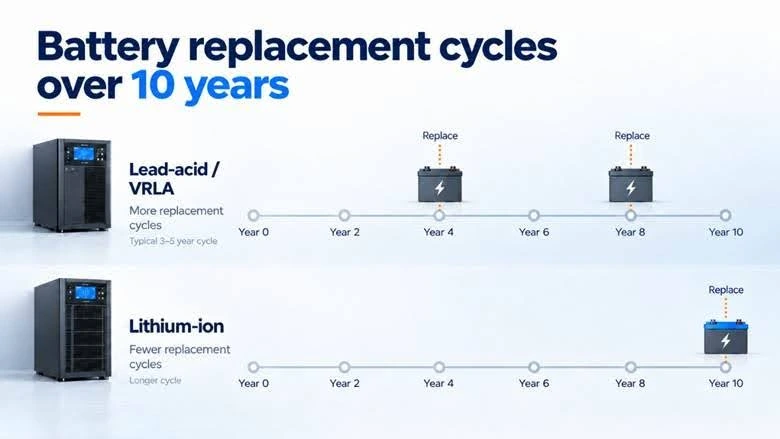
Traditional lead-acid, or VRLA, batteries typically last around 3–5 years.
Lithium-ion batteries can last roughly 2–3 times longer, depending on the system and operating conditions.
In other words, that’s fewer replacement cycles to schedule across every IDF, rack and telecom room.
Take a hospital with 16 UPSs spread across its IDFs and telecom rooms. Using a four-year VRLA replacement cycle, those units could require about 32 battery swaps over 10 years. A lithium-ion system lasting around ten years could cut that in half to about 16.
That’s 16 fewer replacements for IT and facilities teams to purchase, schedule and coordinate…before you even factor in the labor involved.
2. Less maintenance to manage
Every battery swap means labor, access, scheduling and another maintenance window.
Do that across dozens of UPSs and the workload adds up fast.
A longer battery lifecycle means fewer service events competing with all the other infrastructure your IT and facilities teams are already responsible for keeping online.
3. More room in crowded network spaces
IDFs and telecom rooms rarely have space to spare by design.
Lithium-ion batteries are lighter and more compact than comparable lead-acid systems, helping reduce bulk in racks and tight equipment rooms.
That gives teams more flexibility when space is already being squeezed by switches, patching, power and other network hardware.
4. Faster recovery after an outage
A UPS may need to be ready for more than one interruption.
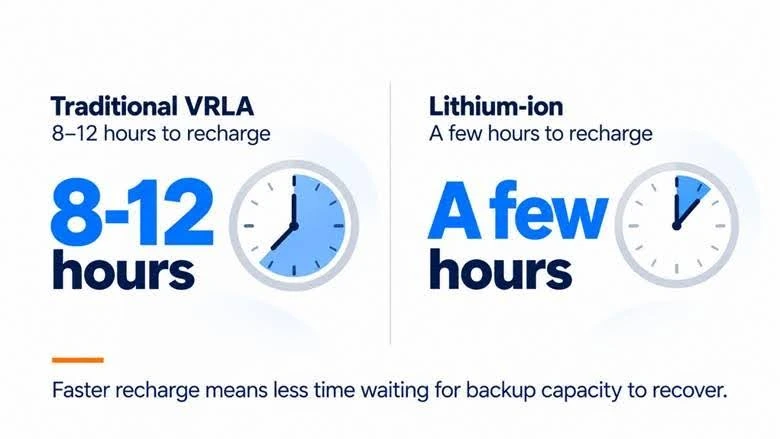
Eaton’s lithium-ion batteries can return to full capacity within a few hours, while traditional lead-acid systems can take 8–12 hours to fully recharge.
For hospital IT and facilities teams, that means less time waiting for backup capacity to fully recover when power conditions remain unstable.
5. Lower lifecycle burden
It’s true that lithium-ion generally costs more upfront.
But fewer battery replacements, fewer service visits and longer battery life can reduce total cost of ownership over time.
That difference becomes much more meaningful when you’re managing dozens of UPSs across an entire hospital, clinic network or campus instead of just one equipment room.
Lead-acid still has a place
VRLA remains a proven, lower-cost option.
If you have only a few UPSs, easy maintenance access and a tighter upfront budget, lead-acid may still make sense.
The real question is what matters more over the life of the system: initial price or ongoing maintenance.
More single-phase options, less maintenance to plan around
If hearing about uninterruptible power supplies has you thinking about Tripp Lite, remember that Eaton acquired the company in 2021, expanding its single-phase UPS portfolio.
Today, they offer lithium-ion options for network closets, IDFs, racks and other distributed IT environments.
And we see another useful Eaton advantage: availability.
The lifecycle benefits of lithium-ion UPSs make the stronger case, but good lead times make it easier to act on that case now.
Cut the recurring UPS workload
If UPSs are spread across your hospital, clinic or campus, lithium-ion may be worth a closer look.
The goal isn’t just longer battery life. It’s fewer replacements, fewer service events and less maintenance for your teams to plan around year after year.
Talk to Capital Electric about Eaton’s options. We’ll help you compare battery types, runtime, capacity and availability to find the right fit.
Call 800-227-9473 or email info@capital-electric.com