
Security + prevention without ripping everything out
Security systems are built incrementally. As new tech emerges, it’s added to an ever-growing, increasingly chaotic ecosystem.
Walk into almost any project today and you’ll see how much has changed.
There’s more connected technology in buildings than ever before: cameras, paging systems, environmental sensors, displays, access control, etc. Every system is there for a reason, each one adding another layer of visibility.
But they don’t always work together.
Instead, they get installed side by side.
Separate devices.
Separate runs.
Separate points of management.
And when something actually happens, the information often lives in different places. Situational awareness isn’t being harnessed.
That’s exactly the problem AtlasIED is addressing with its AIX platform — announced at ISC West in March — a system that fits neatly into real-world security deployments, unifying communication, sensing and response without ripping out what’s already installed.
AIX: Built to connect what’s already there
AtlasIED’s AIX platform was created around a simple idea: technology in critical environments should evolve, not be replaced.
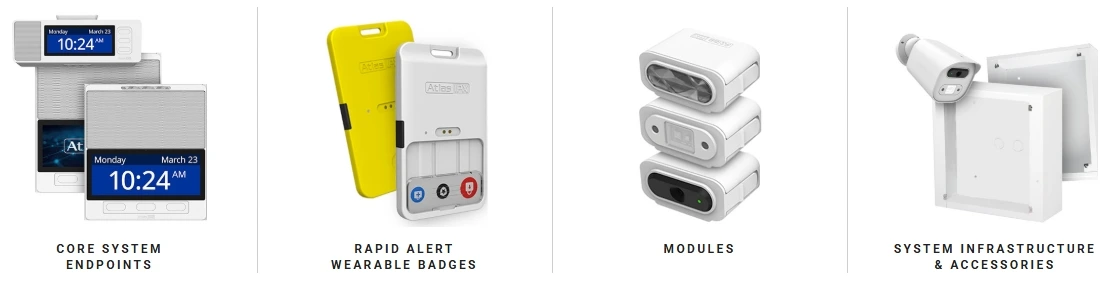
The AIX series delivers that in the form of a modular platform that works across:
- Endpoints that combine audio, visual alerts and sensing at a single location
- Wearable devices that let people trigger alerts directly (more on that below)
- Modular components that expand sensing and detection capabilities
- Infrastructure and management tools that support deployment across different environments
All of it consolidated into a single drop, moving from gear that coexists to gear that communicates. Because most facilities aren’t starting from scratch. They’re layering new capabilities onto existing infrastructure.
Endpoints: more than comms
The center of the AIX world is next-gen IP endpoints, all running over a single PoE++ network drop and combining:
- Speakers for paging, talkdown and mass communication
- Visual displays for alerts, signage and instructions
- Intercom functionality
- Integrated environmental sensing for
- Temperature
- Air quality
- VOCs
- eCO₂
The result is simpler infrastructure with more capability at each location, with endpoints that identify conditions and trigger responses directly at the edge, where the decisions need to happen.
That’s where systems start moving from reactive to preventative.
And that’s just the start of the expandable nature of AIX.
Modular architecture: add capability without starting over
One of the biggest challenges in security infrastructure is how quickly requirements change.
New threats. New expectations. New technology.
Most systems handle that by piling on additional hardware or replacing what’s already installed.
AIX is built differently.
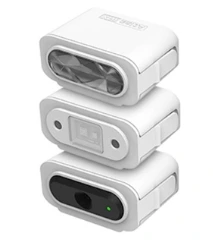
Endpoints include expansion capability, allowing new functions to be added over time without replacing the core device.
That includes modules for:
- Gunshot detection using acoustic and IR-based sensing
- Camera-based object or weapon detection at the edge
- Visual signaling and notification enhancements
This plug-and-play approach allows systems to evolve incrementally, rather than forcing major upgrades.
It also keeps deployments aligned with how projects actually move; phased, budget-conscious and constantly adapting.
Wearables: closing the coverage gaps

Even the best detection systems have blind spots, situations only someone on-site can recognize in the moment.
AIX addresses that with its lightweight Rapid Alert wearable badges.
These devices give staff or visitors a direct way to initiate a response, get help or trigger a response without relying on phones, apps or Wi-Fi network access.

With the press of a button, the white staff badge can:
- Trigger a lockdown
- Get security assistance
- Summon medical support
The visitor badges are:
- Bright yellow for easy identification
- Configurable with time and access rules
- Able to call for help via a single button
In environments like schools, healthcare facilities or campuses, location context and the ability to raise the alarm instantly removes friction at the moment it matters most.
Single-screen management for total system awareness
As endpoints become more capable, they also become more complex to manage.
More features mean more configuration, more dependencies and more points of failure if things aren’t maintained properly.
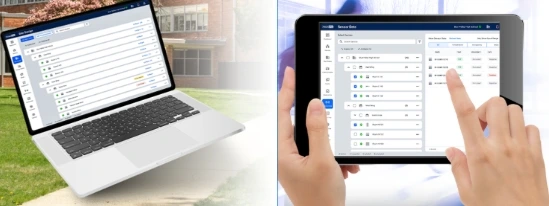
That’s where Site Manager comes in.
Instead of treating devices as isolated components, it manages them as part of a system at the device layer, controlling:
- Configuration and setup
- Firmware updates
- System monitoring and health
- Readiness and status visibility
By providing a clear view into the health of the entire system, Site Manager reduces risk and uncertainty and helps maintain trust in the infrastructure.
Is AIX right for you?
Security systems aren’t getting simpler.
More devices, more data and higher expectations around response are putting pressure on how these systems are designed and managed.
The challenge is making sure what you already have in place works together in a way that actually improves security, awareness and response while being ready for expansion when required.
That’s where platforms like AIX are shifting the conversation.
Curious about how AIX could fit into your next project? Give us a call at 262-788-9700 and we’ll take you through the ins and outs.